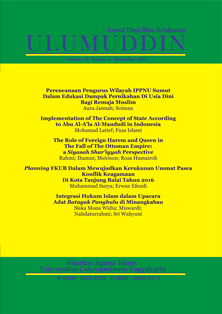
The Role of Foreign Harem and Queen In The Fall of The Ottoman Empire: A Siyasah Shar'iyyah Perspective
DOI:
https://doi.org/10.47200/ulumuddin.v15i2.2855Keywords:
Collapse, Foreign Women, OttomanAbstract
The article from this research aims to explain the role of women and foreign women in the Ottoman government, which had positive and negative impacts on the Empire. At first, the role of women was not very prominent in government. However, women behind the scenes produced strong leaders who could increase the age of this Empire and experience a period of glory starting with the reign of Usman I. In Sultan Suleiman the Magnificent, the role of foreign women and enslaved people became more prominent. Repeated attempts by women in power at the Ottoman court to take different roles profoundly affected the state's internal structure in the long term, especially in foreign diplomacy. The mothers and wives of the sultans could build entities within the state, and they had supporters from ministries and the army. It is worth noting that "one of the most important factors in halting the progress, and even setting back the Ottoman Empire, was the interference of the sultan's foreign wives and mothers for almost a century in state affairs." Court ladies strongly influenced the sultans, especially in the 17th Century, when the state was sometimes under their rule. The welfare of Muslims was disrupted in areas of Russia, Eastern Europe, Malaysia, and Indonesia.
Downloads
References
Ágoston, Gábor, and Bruce Alan Masters, eds. Encyclopedia of the Ottoman Empire. Facts on File library of world history. New York, NY: Facts On File, 2009.
Alam, Muzaffar. The Languages of Political Islam: India, 1200-1800 / Muzaffar Alam. Chicago: University of Chicago Press, 2004.
Andersen, Angela. “Review: textit{{Architecture}} and {Hagiography} in the {Ottoman} {Empire}: {The} {Politics} of {Bektashi} {Shrines} in the {Classical} {Age} , by {Zeynep} {Yürekli}.” Journal of the Society of Architectural Historians 74, no. 3 (September 2015): 367–368.
Andrew Peacock. Ottoman Expedition to Aceh. Place of publication not identified: Betascript Publishing, 2011.
———. Ottoman Expedition to Aceh. Place of publication not identified: Betascript Publishing, 2011.
Antov, Nikolay. "II. Conversion, Apostasy, And Relations Between Muslims And Non-Muslims: Fatwas Of The Ottoman Shaykh Al-Islams." The Empires of the Near East and India (August 1, 2019): 32–54.
Atçıl, Abdurrahman. Scholars and Sultans in the Early Modern Ottoman Empire, 2017.
———. Scholars and Sultans in the Early Modern Ottoman Empire, 2017.
Barzilai-Lumbroso, Ruth. “Turkish {Men} and the {History} of {Ottoman} {Women}.” Journal of Middle East Women's Studies 5, no. 2 (July 2009): 53–82.
———. "Turkish Men and the History of Ottoman Women." Journal of Middle East Women's Studies 5, no. 2 (July 1, 2009): 53–82.
Buehler, Arthur F. “III. Sufism And The Divine Law: Ahmad Sirhindi's Ruminations." The Empires of the Near East and India (August 1, 2019): 160–174.
Casale, Giancarlo. The Ottoman Age of Exploration. Oxford: Oxford University Press, 2010.
———. The Ottoman Age of Exploration. Oxford: Oxford University Press, 2010.
Clay, C G A. Gold for the Sultan: Western Bankers and Ottoman Finance 1856-1881: A Contribution to Ottoman and International Financial History. International library of historical studies. London ; New York : New York, NY: I.B. Tauris ; In the U.S.A. and Canada distributed by St. Martin's Press, 2000.
Cohen, Amnon. "The Ottoman Approach to {Christians and {Christianity} in Sixteenth‐century Jerusalem}." Islam and Christian–Muslim Relations 7, no. 2 (June 1996): 205–212.
———. "The Ottoman Approach to Christians and Christianity in Sixteenth‐century Jerusalem." Islam and Christian–Muslim Relations 7, no. 2 (June 1996): 205–212.
Davies, Brian L. The Russo-Turkish War, 1768-1774: Catherine II and the Ottoman Empire. London: Bloomsbury Academic, an imprint of Bloomsbury Publishing Plc, 2016.
Didi, A.A.A. السلطة التشريعية في المالديف: مقارنة بالنظام السياسي الإسلامي والأنظمة السياسة المعاصرة. Jami’at al-Azhar, Kulliyat al-Shari’ah wa al-Qanun, 1999. https://books.google.co.id/books?id=CtYinQAACAAJ.
Farid Bek Al-Muhami, Muhammad. Tarij Al-Dawla al-’aliyya al-’utmaniyya. Beirut: Dar al-Nafa' is, 2009.
———. Tarij al-dawla al-’aliyya al-’utmaniyya. Beirut: Dar al-Nafa’ is, 2009.
Hasan Najar, Ahmad Nabil. الدولة العثمانية: قراءة جديدة لعوامل الانحطاط, 2020.
———. الدولة العثمانية: قراءة جديدة لعوامل الانحطاط, 2020.
İnalcık, Halil. The Ottoman Empire: The Classical Age 1300-1600. London: Phoenix Press, 2000.
İnalcık, Halil, Norman Itzkowitz, and Colin Imber. The Ottoman Empire: The Classical Age, 1300-1600, 2013.
Kadı, İsmail Hakkı, A C Peacock, and Giancarlo Casale. Ottoman-{Southeast} {Asian} {Relations}: Sources from the {Ottoman} {Archives}. Leiden ; Boston: Brill, 2020.
Kennedy, Hugh. "The Early Abbasid Caliphate: {A} Political History." The Early Abbasid Caliphate: A Political History (January 2016): 1–238.
Kinross, Patrick Balfour. The Ottoman Centuries: The Rise and Fall of the Turkish Empire. Morrow Quill paperbacks. New York, N.Y: Morrow, 2020.
Mauder, Christian. In the Sultan's Salon: Learning, Religion and Rulership at the Mamluk Court of Qāniṣawh al-Ghawrī (r. 1501-1516). Islamic history and civilization. Leiden ; Boston: Brill, 2021.
Peirce, Leslie P. Imperial Harem: Women and Sovereignty in the Ottoman Empire. New ed. Studies in {Middle} {Eastern} {History}. New York: Oxford University Press, 1994.
Peirce, Leslie P. Imperial Harem: Women and Sovereignty in the Ottoman Empire. New ed. Studies in Middle Eastern History. New York: Oxford University Press, 1994.
Sowerby, Tracey Amanda, and Christopher Markiewicz. Diplomatic Cultures at the Ottoman Court, c.1500-1630. Routledge research in early modern history. New York (N.Y.): Routledge, Taylor & Francis Group, 2021.
Yilmaz, Hüseyin. "II. Kingship and Legitimacy in the Sixteenth-Century Ottoman Empire." The Empires of the Near East and India (August 1, 2019): 193–204.
Zasztowt, Konrad. "The Crimean Tatar Muslim Community: Between Annexed Crimea and Mainland Ukraine." Studia Religiologica 52, no. 1 (2019): 27–48.
احسان, أوغلي، أكمل الدين, and مركز الابحاث للتأريخ والفنون والثقافة الاسلامية. الدولة العثمانية تاريخ وحضارة. سلسلة الدولة العثمانية تاريخ وحضارة ؛. مركز الابحاث للتأريخ والفنون والثقافة الاسلامية،, 1999. https://books.google.co.id/books?id=8uYrwAEACAAJ.
البستانى, سليمان. عبرة وذكرى او الدولة العثمانية قبل الدستور وبعده. دار الأخبار, 1908. https://books.google.co.id/books?id=nWYrkgAACAAJ.
———. عبرة وذكرى او الدولة العثمانية قبل الدستور وبعده. دار الأخبار, 1908. https://books.google.co.id/books?id=nWYrkgAACAAJ.
ترجمها عن النص الأصلي وكتب مقدمتها وحواشيها وقابلها بمذكرات للمعاصرين محمد حرب., and عبد الحميد II، سلطان الترك،, 1918-1842. مذكرات السلطان عبد الحميد. Translated by حرب، محمد. Al-Ṭabʻah. Dimashq: دار القلم, 2018.
عبداللي, إلبر أورطايلي - ترجمة عبد القادر. الخلافة العثمانية: التحديث والحداثة في القرن التاسع عشر. مكتبة بستان المعرفة للطباعة والنشر والتوزيع, 2007. https://books.google.co.id/books?id=7QretAEACAAJ.
“The Destruction and Burning of {Moscow}: {Devlet} {I} {Giray}’s {Crimean} Campaign.” Crimea Platform, n.d.
“الدولة العثمانية.. تربة خصبة للقيادة النسائية ومقومات النهوض بالمرأة | نون بوست.” Accessed August 17, 2023. https://www.noonpost.com/content/40064.
“لماذا أمر السلطان سليمان القانوني بقتل ابنه مصطفى؟ – إضاءات.” Accessed July 28, 2024. https://www.ida2at.com/why-did-sultan-suleiman-alkanoni-give-an-order-to-kill-his-son-mustafa/.
Downloads
Published
How to Cite
Issue
Section
License
Copyright (c) 2025 Rahmi, Ilhamni, Meirison Meirison, Roza Humairoh

This work is licensed under a Creative Commons Attribution-ShareAlike 4.0 International License.