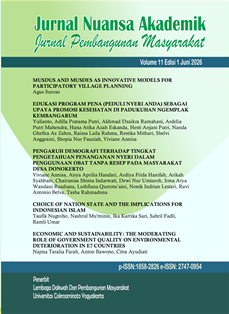
Economic and Sustainability: The Moderating Role of Government Quality on Environmental Deterioration in E7 Countries
DOI:
https://doi.org/10.47200/jnajpm.v11i1.3296Keywords:
emerging seven (E7), generalized method of moments (gmm), moderated regression analysis (mra), foreign direct investment (fdi), carbon emissionsAbstract
This study aims to analyze the balance between economic growth and environmental sustainability by considering the moderating role of government quality in Emerging Seven (E7) countries using a quantitative methodology utilizing panel data from 2015 to 2024, along with the Generalized Method of Moments (GMM) and Moderated Regression Analysis (MRA) to examine the causal relationships between variables. The findings indicate that economic growth and population metrics have a positive impact on carbon emission escalation, while trade openness does not appear to have a statistically significant effect. In contrast, Foreign Direct Investment (FDI) initially presents a negative effect on carbon emissions, which shifts to a positive correlation in the context of declining government quality. This demonstrates that good governance can strengthen efforts to control carbon emissions and promote sustainable development. Thus, institutional capacity building and robust environmental policies are key to balancing economic growth and environmental preservation in E7 countries.
Downloads
References
Ali, Hamisu Sadi, Siong Hook Law, dan Talha Ibrahim Zannah. 2016. “Dynamic impact of urbanization, economic growth, energy consumption, and trade openness on CO 2 emissions in Nigeria.” Environmental Science and Pollution Research 23(12):12435–43. doi: 10.1007/s11356-016-6437-3.
Antweiler, Werner, Brian R. Copeland, dan M. Scott Taylor. 2001. “Is free trade good for the environment?” American Economic Review 91(4):877–908. doi: 10.1257/aer.91.4.877.
Arellano, Manuel, dan Stephen Bond. 1991. “Some Test of Spesification for Data Panel: Monte Carlo Evidence and an Aplication of Employment Equations.” Source: The Review of Economic Studies 58(2):277–97. doi: https://doi.org/10.2307/2297968.
Bagadeem, Salim, Raheel Gohar, Wing Keung Wong, Asma Salman, dan Bisharat Hussain Chang. 2024. “Nexus between foreign direct investment, trade openness, and carbon emissions: fresh insights using innovative methodologies.” Cogent Economics and Finance 12(1):1–13. doi: 10.1080/23322039.2023.2295721.
Baltagi, Badi H. 2005. Econometric Analisis of Panel Data. Vol. 16. Third. England: Jhon Wiley and Son Ltd.
Bergougui, Brahim, Reda Hamza Boudjana, Samer Mehibel, dan Manuel A. Zambrano-Monserrate. 2024. “How do institutional quality and income asymmetrically affect carbon emissions inequality? A quantile-on-quantile assessment for six major global emitters.” Journal of Cleaner Production 483(August):144215. doi: 10.1016/j.jclepro.2024.144215.
Birgitta Sekar Winda, Telisa Aulia Falianty. 2023. “Pengaruh Foreign Direct Investment terhadap Emisi Gas CO2 di Negara G20.” Al Qalam: Jurnal Ilmiah Keagamaan dan Kemasyarakatan 17(3):1989–2002. doi: 10.35931/aq.v17i3.2163.
Blundell, Richard, dan Stephen Bond. 1998. “Initial conditions and moment restrictions in dynamic panel data models.” Journal of Econometrics 87 115–43. doi: 10.1016/j.jeconom.2023.03.001.
Carlos, Nuno, dan Daniel Balsalobre Lorente. 2020. “Trade : The Evidence for the European Union.” Energies 13(18).
Chiriluș, Alexandru, dan Adrian Costea. 2023. “The Effect of FDI on Environmental Degradation in Romania: Testing the Pollution Haven Hypothesis.” Sustainability (Switzerland) 15(13):3. doi: 10.3390/ su151310733.
Dira, Aldi Friyatna, Kurniawan Prambudi Utomo, Mic Finanto Ario Bangun, Eigis Yani Pramularso, dan Faroman Syarief. 2023. “Pengaruh Investasi dan IPM terhadap Pertumbuhan Ekonomi Hijau di Provinsi Kalimantan Timur.” Ekombis Review: Jurnal Ilmiah Ekonomi dan Bisnis 11(2):1438–39. doi: https://doi.org/10.37676/EKOMBIS.V11I2.4181.
Driscoll, John C., dan Aart C. Kraay. 1998. Consistent Covariance Matrix Estimation With Spatially Dependent Panel Data.
Du, Kerui, Pengzhen Li, dan Zheming Yan. 2019. “Do green technology innovations contribute to carbon dioxide emission reduction? Empirical evidence from patent data.” Technological Forecasting and Social Change 146(April):297–303. doi: 10.1016/j.techfore.2019.06.010.
Ebrahim, Ehab Ebrahim Mohamed, Mohamed R. Abonazel, Awadelkarim Elamin Altahir Ahmed, Suzan Abdel-Rahman, dan Walaa Abdullah Abdullah Albeltagy. 2025. “Analysis of the Economic and Environmental Factors Affecting CO2 Emissions in Egypt: A Proposed Dynamic Econometric Model.” International Journal of Energy Economics and Policy 15(4):152–65. doi: 10.32479/ijeep.19222.
Farah, Najma Taralia, dan Muhammad Rudi Nugroho. 2024. “Pengaruh Ekonomi Dan Non-Ekonomi Terhadap Emisi Karbon Di Negara ASEAN: Analisis Environmental Kuznets Curve.” Nuansa Akademik: Jurnal Pembangunan Masyarakat 9(2):627–42. doi: 10.47200/jnajpm.v9i2.2922.
Fernández Fernández, José Alejandro, Miguel Ángel Casquet Cano, dan Sonia Quiroga. 2024. “‘The interplay between carbon emissions and inequality: A complex networks approach.’” Environmental and Sustainability Indicators 24(July). doi: 10.1016/j.indic.2024.100520.
Hoechle, Daniel. 2007. “Robust standard errors for panel regressions with cross-sectional dependence.” The Stata Journal 7(3):281–312.
Korves, Nicolas, Inmaculada Martinez-Zarzoso, dan Anca Monika. 2011. “Is Free Trade Good or Bad for the Environment? New Empirical Evidence.” Climate Change - Socioeconomic Effects 1–27. doi: 10.5772/23008.
Liang, Yanzi, Saif Ur Rahman, Amira Shafaqat, Arshad Ali, Muhammad Sibt E. Ali, dan Hamayun Khan. 2024. “Assessing sustainable development in E-7 countries: technology innovation, and energy consumption drivers of green growth and environment.” Scientific Reports 14(1):1–21. doi: 10.1038/s41598-024-79908-9.
Mahjabeen, Syed Z. A. Shah, Sumayya Chughtai, dan Biagio Simonetti. 2020. “Renewable energy, institutional stability, environment and economic growth nexus of D-8 countries.” Energy Strategy Reviews 29:100484. doi: 10.1016/j.esr.2020.100484.
Memon, Mumtaz Ali, Jun Hwa Cheah, T. Ramayah, Hiram Ting, Francis Chuah, dan Tat Huei Cham. 2019. “Moderation analysis: Issues and guidelines.” Journal of Applied Structural Equation Modeling 3(1):i–xi. doi: 10.47263/jasem.3(1)01.
Mert, Mehmet, dan Abdullah Emre Caglar. 2020. “Testing pollution haven and pollution halo hypotheses for Turkey: a new perspective.” Environmental Science and Pollution Research 27(26):32933–43. doi: 10.1007/s11356-020-09469-7.
Moody, Carlisle. 2016. Fixed Effects Panel Data Models: To Cluster or Not to Cluster?
Pei, Weiqi, dan Weiran Pei. 2023. “Empirical Study on the Impact of Government Environmental Subsidies on Environmental Performance of Heavily Polluting Enterprises Based on the Regulating Effect of Internal Control.” International Journal of Environmental Research and Public Health Article 20(98):1–17. doi: https://doi.org/10.3390/ijerph20010098.
Rafif, Farhan, Nugroho Sumarjiyanto, dan Benedictus Maria. 2024. “Determinan Emisi Co2 Pada Negara Anggota Asean.” Diponegoro Journal of Economics 13(2):53–68. doi: https://doi.org/10.14710/ djoe.44589.
Rokhmawati, Andewi, Vita Sarasi, dan Lailan Tawila. 2024. “Geography and Sustainability Scenario analysis of the Indonesia carbon tax impact on carbon emissions using system dynamics modeling and STIRPAT model.” Geography and Sustainability 5(4):577–87. doi: 10.1016/j.geosus.2024.07.003.
Sheng, Weiyan, Fei Meng, dan Muhammad Waqas Akbar. 2023. “How institutional quality, and energy production sources, affect the environmental sustainability of bri countries: A comparison of different income groups.” PLoS ONE 18(9 September):1–25. doi: 10.1371/journal.pone.0291144.
Tu, Zhihui, Chen Feng, dan Xin Zhao. 2022. “Revisiting energy efficiency and energy related CO2 emissions: Evidence from RCEP economies.” Economic Research-Ekonomska Istrazivanja 35(1):5858–78. doi: 10.1080/1331677X.2022.2038651.
Van, Loan Thi Hong, Duc Hong Vo, Nam Thanh Vu, Chi Minh Ho, dan Thang Cong Nguyen. 2024. “From foreign direct investment to environmental regulations: Does a feedback effect ever exist?” Heliyon 10(8):e28657. doi: 10.1016/j.heliyon.2024.e28657.
Wafi Dinilhaq, Zul Azhar. 2024. “Analisis Pengaruh Pertumbuhan Ekonomi Terhadap Degradasi Lingkungan di Indonesia.” Media Riset Ekonomi Pembangunan (MedREP) 1(1):9–10. doi: doi:10.24036/medrep.v1i(1).2.
Wooldridge, Jeffrey M. 2016. Econometric Analysis of Cross Section and Panel Data. Vol. 16.
Yu, Cheon, Danilova Nataliia, Seung Jick Yoo, dan Yun Seop Hwang. 2019. “Does trade openness convey a positive impact for the environmental quality? Evidence from a panel of CIS countries.” Eurasian Geography and Economics 60(3):333–56. doi: 10.1080/15387216.2019.1670087.
Zhang, Yue Jun, Yu Lu Peng, Chao Qun Ma, dan Bo Shen. 2017. “Can environmental innovation facilitate carbon emissions reduction? Evidence from China.” Energy Policy 100(October 2016):18–28. doi: 10.1016/j.enpol.2016.10.005.
Downloads
Published
How to Cite
Issue
Section
License
Copyright (c) 2026 Najma Taralia Farah, Anton Bawono, Citra Ayudiati

This work is licensed under a Creative Commons Attribution-ShareAlike 4.0 International License.