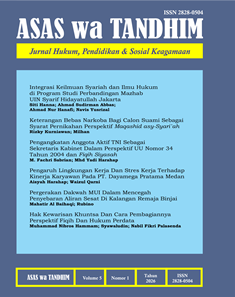
Pengangkatan Anggota Aktif TNI Sebagai Sekretaris Kabinet Dalam Perspektif UU Nomor 34 Tahun 2004 dan Fiqih Siyasah
DOI:
https://doi.org/10.47200/awtjhpsa.v5i1.3083Keywords:
Active Military Personnel, Cabinet Secretary, Appointment, Law, Fiqih siyasahAbstract
The research aims to analyze the legality and constitutional implications of appointing active members of the Indonesian National Armed Forces (TNI) as Cabinet Secretary from the perspective of Law Number 34 of 2004 concerning the TNI and fiqih siyasah. This doctrinal legal research uses legislative, conceptual, and comparative approaches. Data are from manuscript studies of legal materials and fiqih siyasah. The results show that the appointment of active military personnel to strategic civilian positions is contrary to the spirit of military reform and the principle of civilian supremacy. From the perspective of fiqih siyasah, this policy violates the principles of al-'adalah, al-amanah, and al-shura. As a result, it has the potential to undermine bureaucratic accountability, create conflicts of interest, and threaten the democratization of government. Consistency of legislation, strengthening of sharia-based governance ethics and the constitution to maintain the integrity of the state power structure are needed.
Downloads
References
Al-Amin, M. N. K., Santoso, F. S., Murtadho, I., & Wahuri, S. D. (2024). Beyond Marxist Materialism: H.O.S Tjokroaminoto’s Islamic Socialism and Its Maqāṣidī Foundations. Asy-Syir’ah: Jurnal Ilmu Syari’ah Dan Hukum, 58(2), Article 2. https://doi.org/ 10.14421/ajish.v58i2.1596
Albahroyni, A., Sazali, H., & Khatibah, K. (2023). Pengaruh Penyampaian Konten Dakwah Di Tiktok Terhadap Efektifitas Dakwah Salamtv. Nuansa Akademik: Jurnal Pembangunan Masyarakat, 8(2), 345–362. https://doi.org/10.47200/jnajpm.v8i2.1713
Amin, M. N. K. A., Imroatun, Santoso, F. S., Rahayu, S. H., & Chemo, S. (2025). Parenting Styles For Urban Married Couples Who Married Under Age. Proceeding of International Conference on Islamic Education and Science Development, 3(1), Article 1.
Aqil, A. (2023, Oktober 18). Begini Pengawasan Aliran Kepercayaan dan Keagamaan Dalam Masyarakat di Binjai. utamanews.com. https://utamanews.com/sosial-budaya/Begini-Pengawasan-Aliran-Kepercayaan-dan-Keagamaan-Dalam-Masyarakat-di-Binjai
Effendy, O. U. (2023). Ilmu Komunikasi: Teori dan Praktek. Remaja Rosdakarya.
Faizah, F., & Thohri, M. (2018). Strategi Penanganan Paham Keagamaan Menyimpang dalam Perspektif Dakwah (Studi pada Kasus-Kasus yang Ditangani MUI NTB). Jurnal Penelitian Keislaman, 14(1), Article 1. https://doi.org/10.20414/jpk.v14i1.494
Haryanto, A. (2020). Komunikasi Dakwah di Era Digital. Jurnal Komunikasi Islam, 10(1).
Junaidi. (2024, Agustus 6). Diduga Ajarkan Aliran Sesat, Ratusan Massa FUI Geruduk Pesantren Ma’rufatulloh Kolo Saketi. KitaKini News. https://www.kitakini.news/news/13822/diduga-ajarkan-aliran-sesat-ratusan-massa-fui-geruduk-pesantren-ma039rufatulloh-kolo-saketi/
Kemenag, R. (2019). Terjemahan Al-Quran. Lajnah Pentashihan Mushaf Al-Quran.
Lubis, Z. (2023). Tafsir Surat Al-Jinn Ayat 6: Bahaya Meminta Bantuan pada Jin. NU Online. https://www.nu.or.id/tafsir/tafsir-surat-al-jinn-ayat-6-bahaya%20meminta-bantuan-pada-jin-EoBfe
Mahmuddin. (2018). Manajemen Dakwah. Wade Group.
Munir, M. (2017). Manajemen pergerakan dakwah dalam mewujudkan masyarakat madani. Jurnal Manajemen Dakwah, 10(2), 165–180.
Munir, M., & Ilaihi, W. (2021). Manajemen Dakwah,. Kencana Prenada Media.
Nasrullah, A., Hamdi, S., & Awalia, H. (2023). Moderasi Beragama di Kalangan Aktifis Dakwah Kampus Kota Mataram-NTB. Ulumuddin: Jurnal Ilmu-Ilmu Keislaman, 13(2), 343–360. https://doi.org/ 10.47200/ulumuddin.v13i2.1687
Ridho, A. R., & Hariyadi, M. (2021). Reformulasi Etika Dakwah Berbasis Komunikasi Profetik Dalam Al-Qur’an. Komunike: Jurnal Komunikasi Penyiaran Islam, 13(1), Article 1. https://doi.org/ 10.20414/jurkom.v13i1.3351
Ridwan, M., & Mutiawati, M. (2025). Manajemen Al Jam’iyatul Washliyah Sumatera Utara Dalam Program Relawan Dakwah Untuk Daerah Minoritas. Ulumuddin: Jurnal Ilmu-ilmu Keislaman, 15(1), 269–286. https://doi.org/10.47200/ULUMUDDIN.V15I1.2845
Santoso, F. S., & Batubara, I. (2024). The Concept of Justice in the Perspective of Islamic Law: A Comparative Study with Western Legal Philosophy. At-Tasyrih: Jurnal Pendidikan Dan Hukum Islam, 10(2), Article 2. https://doi.org/10.55849/attasyrih.v10i2.263
Sanwar, A. (2019). Ilmu Dakwah: Suatu Pengantar Study. Gunung Jati.
Sembodo, C., Arifin, Z., Rahman, A. S., & Rahayu, S. H. (2025). Waqf Law in the Muslim World: A Study of the Organization and Administration of Waqf in Tunisia. Quru’: Journal of Family Law and Culture, 3(1), Article 1. https://doi.org/10.59698/quru.v3i1.417
Sudury, A. M., Al Faruq, A. Q., & Thobroni, A. Y. (2024). Kajian Tartibunnuzul Dan Sababunnuzul Dalam Ayat-Ayat Khamr Bagi Pengembangan Metode Dakwah. Ulumuddin: Jurnal Ilmu-ilmu Keislaman, 14(2), 361–374. https://doi.org/10.47200/ ULUMUDDIN.V14I2.2650
Suryana, A. (2019). Strategi Komunikasi Dakwah di Media Sosial. Jurnal Penelitian Keislaman, 7(1).
Tohri, M., & Ardian, R. (2020). Restropeksi Sikap MUI NTB Terhadappaham Sempalan Trans-Nasionaldalam Perspektif Manajemen Dakwah. Mudabbir: Jurnal Manajemen Dakwah, 1(1), Article 1.
Yuliyatun, Y. (2016). Manajemen dakwah organisasi Islam: Menjawab Konflik Keberagamaan dan Intoleransi Kaum Radikal. Tadbir: Jurnal Manajemen Dakwah, 1(2), 45–66.
Downloads
Published
How to Cite
Issue
Section
License
Copyright (c) 2025 M Fachri Sabrian, Mhd Yadi Harahap

This work is licensed under a Creative Commons Attribution-ShareAlike 4.0 International License.